BDI System Architecture
Overview
The Build Data Interpreter (BDI) validates aircraft configuration changes through containerized BDI Pods.
The diagram below represents the main interaction points between the BDI pods and the Maximo Manage application and database:
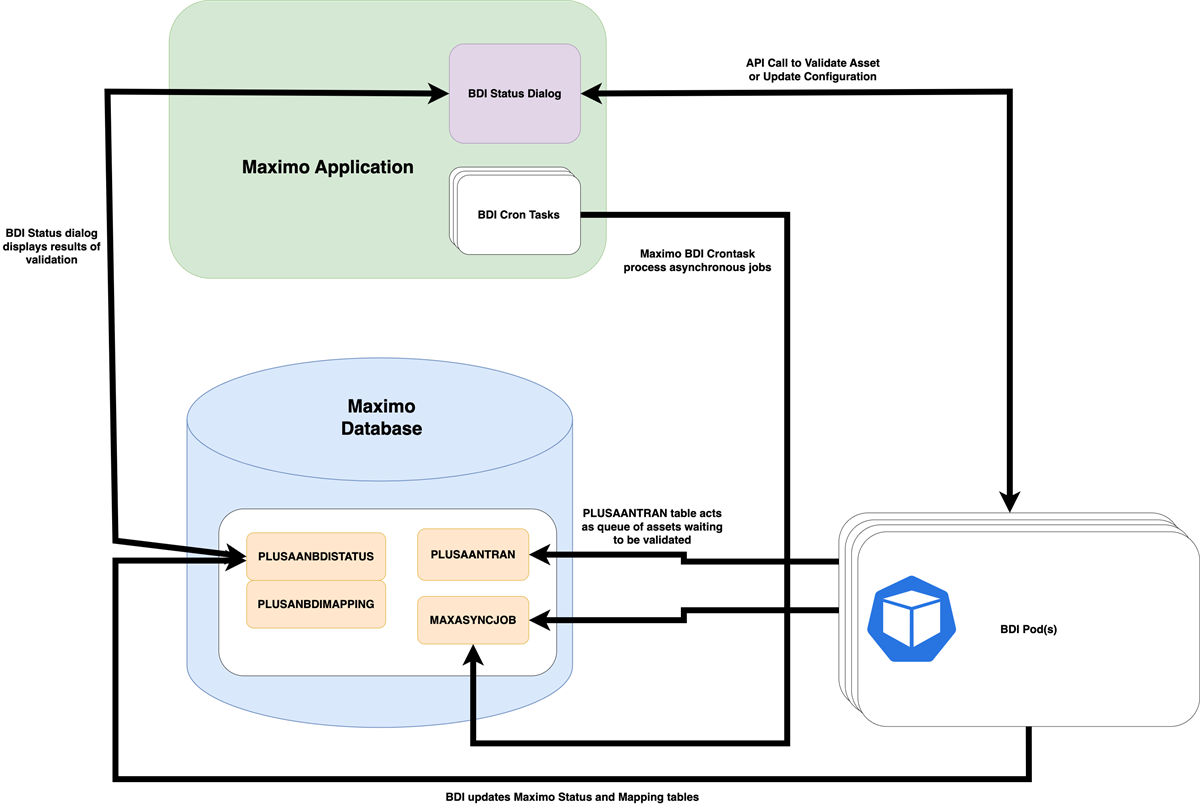
Architecture Components
Maximo Application Layer
BDI Status Dialog
Interactive UI for configuration validation:
- Displays current and alternate configurations
- Initiates validation via API calls
- Shows validation results
BDI Cron Tasks
Process Asynchronous jobs generated by the BDI
- Monitors MAXASYNCJOB queue for submitted jobs
- Submits jobs for processing using Maximo Business Objext (MBO) logic
- Update job status to COMPLETE or ERROR despending on result of processing.
If BDI Cron Tasks stop running, asynchronous jobs will not be processed and import actions such as automatic work order generation may cease.
Maximo Database Layer
Four key tables coordinate BDI workflow:
PLUSAANTRAN (Transaction Queue)
Primary queue for assets awaiting validation:
- Stores asset identifiers and configuration details
- Tracks transaction status (pending, processing, completed)
- Monitored by BDI "Queue Monitor" component within the BDI pod(s)
PLUSAANBDISTATUS (Validation Status)
Stores configuration validation result status on a per asset basis
- Default status values are: OK, INVALID, ALERT
PLUSANBDIMAPPING (Problem Codes)
List problems related to the current as-maintained asset configuration.
- 3 letter problem code defines the type of problem
- Severity defines the effect on overall configuration status
- Narrative gives a desription of the source of the problem.
BDI Pod(s) Processing Layer
Containerized service performing validation logic:
Deployment:
- Kubernetes-based orchestration
- Multiple pods can be configured for high availability
- Horizontal scaling based on workload
- Independent lifecycle from Maximo
Conclusion
The BDI architecture provides scalable, resilient validation of complex aircraft configurations through:
- Scalability: Horizontal pod scaling for increased volume
- Resilience: Fault tolerance via multiple pods and database-backed queues
- Performance: Asynchronous processing prevents user operation blocking
- Flexibility: Rule-based validation supports diverse aircraft types
- Compliance: Comprehensive audit trail for regulatory requirements
Understanding this architecture is essential for proper sizing, deployment, and maintenance of BDI systems in production environments.